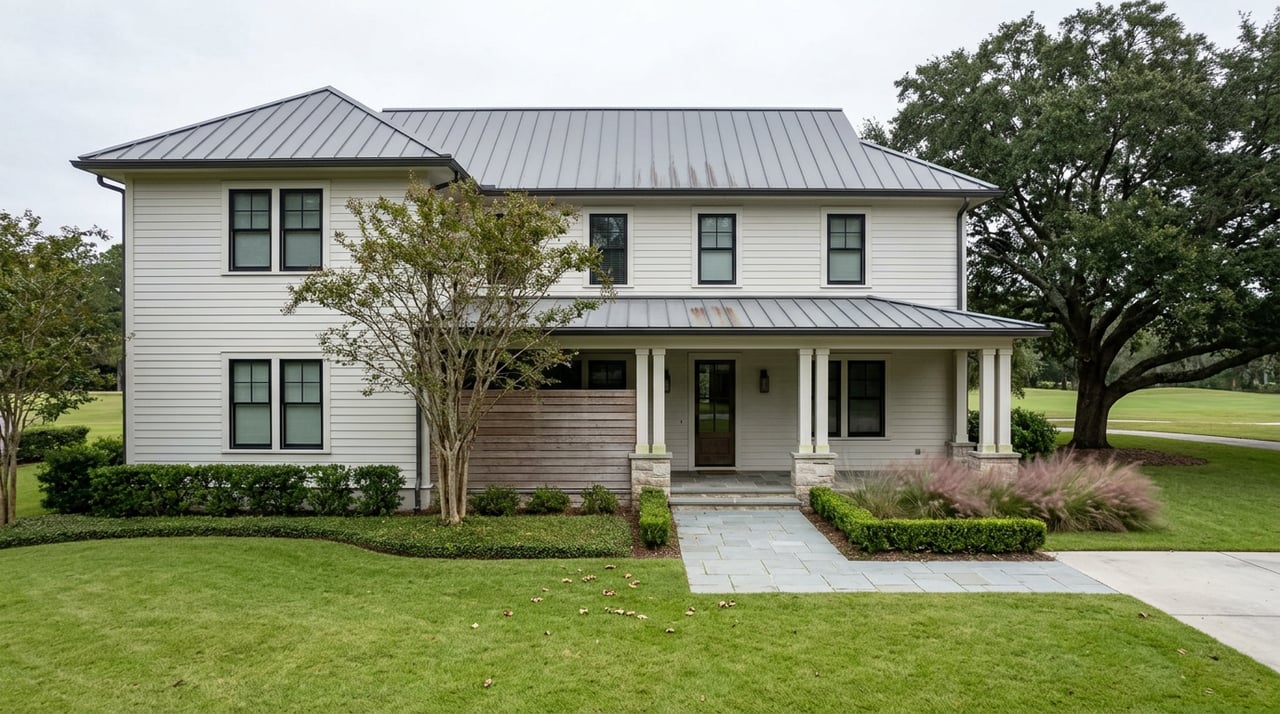
Leland NC Master-Planned Community HOA Fees: Compare the Full Cost
September 24, 2026
September 24, 2026
What does it actually cost to live inside one of Leland's resort-style communities? The total can vary, even when the HOA figures look similar on paper.
That's why it pays to compare more than the HOA number. Buyers comparing Brunswick Forest and Compass Pointe, or weighing either against Mallory Creek Plantation or Magnolia Greens, tend to shop the HOA number the way they'd shop a price tag. But in Leland's master-planned market, the HOA line on a listing sheet describes a structure, not a total. Two homes with nearly identical dues can deliver very different amenity packages, and two communities that both promise a "resort lifestyle" can price that lifestyle in completely different ways. Understanding the difference is the part of the comparison most buyers skip, right up until they're staring at a resale certificate during due diligence.
Compass Pointe markets itself as the resort-lifestyle answer in northern Brunswick County, and the gated, roughly 2,200-acre community backs that up with a 410-foot lazy river, a zero-entry indoor pool, and a clubhouse built around what residents call the Grand Lanai. Standard HOA dues there run somewhere in the $3,000 to $4,300-plus annual range depending on the section, and that fee covers the gates, the common landscaping, the trails, and the pool complex.
What it does not cover is golf. The Compass Pointe Golf Club, an 18-hole championship course designed by Rick Robbins, operates as a private club with its own Golf, Club, and Social membership tiers, entirely separate from HOA dues. You can live inside the gates and never see an invoice from the club, but if playing the course is part of why you're moving there, that's a second, separate financial commitment in addition to the quoted HOA figure.
Several sections within Compass Pointe, including newer patio home and villa neighborhoods, carry mandatory lawn care and irrigation packages baked into a sub-HOA fee schedule. Those packages can add roughly $180 to $250 a month on top of standard dues. For a buyer who wants to lock the door and travel for three months without worrying about the yard, that's a fair trade. For a buyer comparing costs, the lawn package is another expense beyond standard dues.
Cross the highway to Brunswick Forest and the math works differently. The community, which spans roughly 4,500 acres and is planned for thousands of homes at buildout, structures its dues so that nearly every shared amenity comes bundled into one HOA payment. The fitness and wellness centers, the indoor and outdoor pools, tennis and pickleball courts, more than 100 miles of trails, and the kayak launch on Town Creek are all part of standard homeownership there. No separate club membership required.
The one clean exception is golf. Cape Fear National, the public-access course that winds through the community, is open to any golfer willing to pay greens fees, residents included, but playing it isn't tied to your HOA dues one way or the other. That's a meaningfully different arrangement than Compass Pointe's private, membership-gated course.
Where Brunswick Forest gets complicated is in how much dues vary by neighborhood rather than by amenity access. Because the community includes a master association layered over multiple neighborhood sub-associations, a townhome in a maintenance-included section can carry a materially different fee than a single-family home in a section where owners handle their own yards. Annual dues across the community commonly land in the $2,100 to $3,000 range for standard single-family sections, though some maintenance-included neighborhoods run higher. The amenities don't change. What changes is whether your fee includes someone else mowing your lawn.
Put two nearly identical scenarios side by side and the gap becomes obvious.
| Brunswick Forest | Compass Pointe | |
|---|---|---|
| Typical standard-section HOA dues | roughly $2,100–$3,000/year | roughly $3,000–$4,300+/year |
| Amenities included in base dues | Pools, fitness centers, trails, pickleball, kayak launch, dog park | Gates, common landscaping, trails, resort pool, Grand Lanai |
| Golf | Public-access Cape Fear National, greens fees separate, no membership required | Private Rick Robbins-designed course, requires separate Golf/Club/Social membership |
| Mandatory lawn/irrigation add-on | Only in specific maintenance-included sections | Common in villa and patio home sections, roughly $180–$250/month |
| Governance | Master association plus neighborhood sub-associations | Master HOA plus club membership managed separately |
Notice what the table does not show. It doesn't show one community being more expensive than the other in any fixed sense, because that depends entirely on which section you buy into and whether you plan to golf. A buyer who wants low-maintenance living and doesn't care about a private course might find Compass Pointe's villa sections, lawn package included, comparable in total monthly cost to a Brunswick Forest maintenance-included section. A buyer who wants public-access golf without a second membership bill will find Brunswick Forest's structure friendlier to that specific goal.
That's the real finding here, and it cuts against how most people shop these communities. The HOA number by itself tells you almost nothing about what you'll actually pay to live the lifestyle you're picturing. The structure behind the number tells you everything.
Not every Leland option carries this kind of layered fee architecture. Mallory Creek Plantation, for instance, keeps things simpler with two pools, clubhouse space, and trail access, and sub-association dues that commonly run somewhere between $600 and $1,020 a year, a fraction of what either Brunswick Forest or Compass Pointe charges. Magnolia Greens, one of the more established communities in the area, pairs a public-access golf course with pricing that tends to run more accessible than the newer amenity-heavy developments. Grayson Park leans toward attainable new construction with a lower-maintenance product mix and a smaller amenity footprint than the two flagship communities.
None of that makes one community better than another. It makes them built for different priorities. A buyer chasing the lowest possible carrying cost has real options in Leland that don't involve a resort pool complex or a private course. A buyer who wants that full amenity experience needs to go in understanding exactly which parts of it are bundled and which parts show up as a second bill.
Before signing, ask directly about the distinctions above:
The resale certificate and the recorded declaration are where the real answers live, not the marketing brochure. Both are available through the association or through the closing attorney during due diligence, and they're worth reading before you fall in love with a floor plan.
Is Compass Pointe an age-restricted community? The community isn't uniformly age-restricted under a simple legal rule the way a 55-plus designation would apply. Buyers should confirm the specific status in the CC&Rs for their section rather than assuming based on marketing language.
Do I have to join the club to live in either community? No, in both Brunswick Forest and Compass Pointe, golf and club memberships are optional and separate from HOA dues. You can own a home in either place without ever joining, though at Compass Pointe that means the private course simply isn't available to you unless you pay for membership.
Are HOA dues the same as property taxes? No. HOA dues fund the association's operations, common area maintenance, and amenities. Property taxes are billed separately by the county and are not something the HOA structure changes.
If you're comparing Leland's master-planned communities and want someone to pull the actual resale certificate and dues schedule before you make an offer, that's the kind of groundwork Hank Troscianiec & Associates handles for buyers every day. Reach out to schedule a free consultation and we'll walk through the fee structure for the specific neighborhoods on your list, not just the number on the flyer.
This article is general information, not legal, tax or financial advice. Consult a qualified professional about your situation.


Neighborhood Events
We pride ourselves in providing personalized solutions that bring our clients closer to their dream properties and enhance their long-term wealth. Contact us today to find out how we can be of assistance to you!